

Tidal Marsh Birds
An index of breeding population density for three tidal marsh bird species in the San Francisco Bay

Common Yellowthroat. Channel City Camera Club. CC BY 2.0. Cropped, colored, textured.
The Chorus of Tidal Marsh Birds is a Living Signature of a Healthy Marsh

Tidal Marsh Birds
Status & Trend
Latest Update: October 2025



Full read
Tidal Marsh Birds in Depth
The Estuary’s tidal marsh habitat has been dramatically altered in the past two centuries (see Tidal Marsh Indicator). The reduction in area and quality, fragmentation of remaining habitat, and the spread of invasive species have all contributed to declines in the population size and viability of tidal marsh bird species (Takekawa et al. 2012).
For these reasons, many of the species and subspecies that depend on tidal marsh are currently listed as Federally- or State-threatened or endangered, or are designated as California Species of Special Concern (Shuford & Gardali 2008). As such, current management and restoration by agencies and non-governmental organizations have been directed at recovering depleted populations and ensuring their stability.
The 2025 indicator update reflects an overall mixed, though relatively positive, picture. Two out of the three species demonstrate an increase in density over the entire period, whereas Song Sparrows show no significant change. Yet, there is no evidence of a decline in density either for any individual species or for the 3-species indicator overall.
Our conclusion is that habitat suitability is currently sufficient to maintain populations at their current density, and possibly is sufficient to support further increases in density, at least for the Black Rail and Common Yellowthroat. Furthermore, an increase in density is expected to become evident in recently restored marshes as they become more mature, thereby increasing their ability to support growing populations of tidal marsh bird species. The forecast for the near future is encouraging.
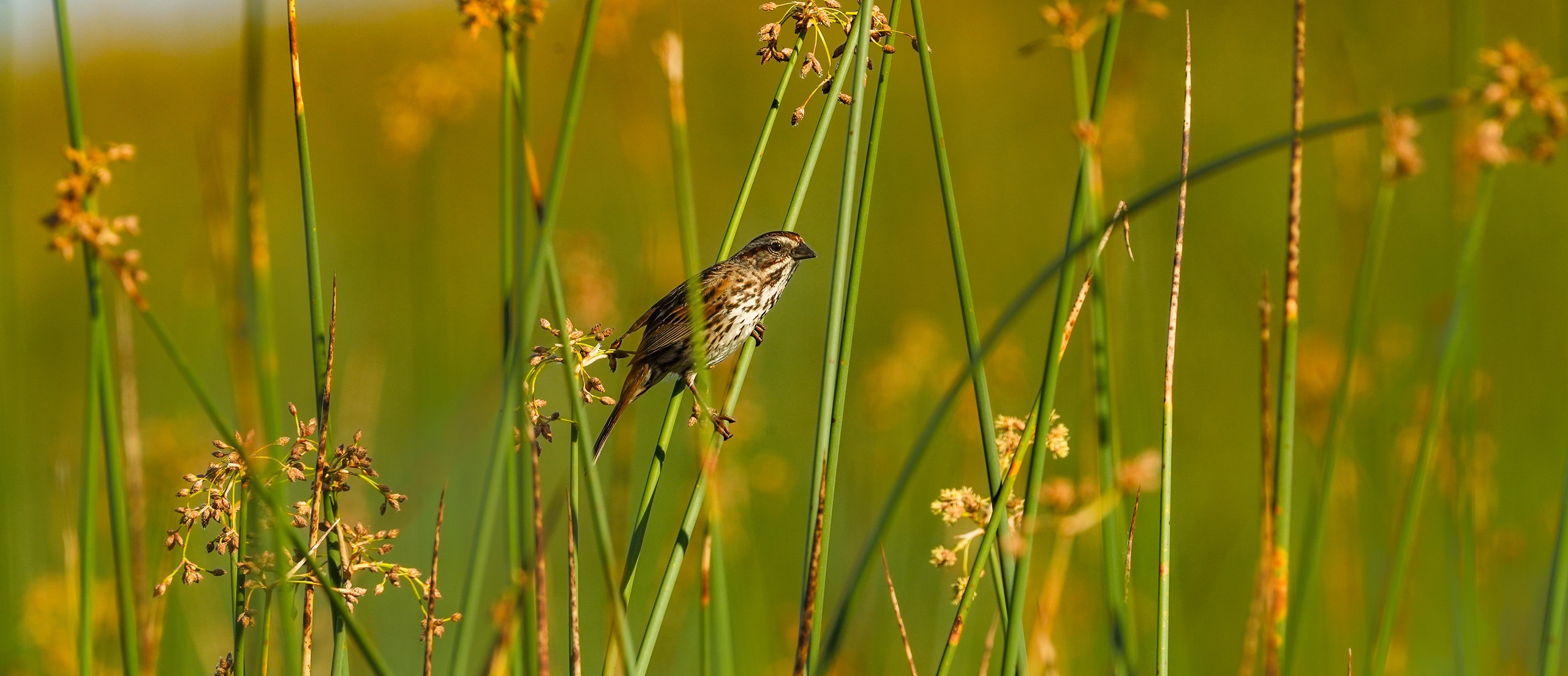
Song Sparrow in a marsh.
How was this Indicator Calculated?
Data Used
We used data derived from standardized, avian tidal marsh surveys conducted by Point Blue Conservation Science in the San Francisco Bay (not including Suisun Bay) from 1996-2024 (Nur et al. 1997, Spautz et al. 2006, Stralberg et al. 2010, Wood et al. 2012).
Indicator Approach
For each of three species—Black Rail (Laterallus jamaicensis), Song Sparrow (Melospiza melodia), and Common Yellowthroat (Geothlypis trichas)—we calculated the average number of individuals detected per visit and survey station per species across all sampled marshes for each year (1996-2024). We then statistically modeled the variation in these average bird counts for all three species in a single model and estimated year to year change in the tidal marsh bird index, while also statistically controlling for marsh site and species effects. From this model we obtained annual estimates of the tidal marsh bird population index and an estimate of annual change in the population index over the entire period of data collection (1996 – 2024).
Benchmarks and Scoring
We assigned status scores by comparing data from surveyed marshes during the most recent four years (2021-2024) to data from surveyed marshes during the baseline period (1996-2008). The benchmark between Good and Fair is the 75th percentile of tidal marsh bird density during the baseline years, and the benchmark between Fair and Poor is 25% below the baseline period mean value. We assigned a trend score by estimating the annual change in the population index (1996-2024) and reporting its significance level (assuming α = 0.05).
Technical Appendix

Download PDF
Related Indicators
Flourishing Wildlife Category

Harbor Seals
Tracks adult harbor seal abundance in the San Francisco Bay during the breeding season (Under development)
Native Fish
Measures the abundance, species diversity, species composition, and distribution of native fishes in the San Francisco Estuary
Ridgway's Rail
Tracks Ridgway’s Rail population density in tidal marsh habitats of the San Francisco Bay (Under development)
Shorebirds
Tracks winter densities of migratory shorebirds in the San Francisco Bay
Waterfowl
An index of winter abundance for dabbling and diving ducks in the San Francisco Bay
Contributing Scientists | Tidal Marsh Birds
Nadav Nur, PhD, Point Blue Conservation Science
Julian Wood, Point Blue Conservation Science
Citations
-
Nur, N., S. Zack, J. Evans, and T. Gardali. 1997.
Tidal marsh birds of the San Francisco Bay region: status, distribution, and conservation of five Category 2 taxa. Report of the Point Reyes Bird Observatory, Stinson Beach, CA 94970 to USGS-Biological Resources Division. Available from Point Blue Conservation Science, Petaluma, CA. -
Spautz, H., N. Nur, D. Stralberg, and Y. Chan. 2006.
Multiple-scale habitat relationships of tidal-marsh breeding birds in the San Francisco Bay estuary. Studies in Avian Biology 32:247–269. -
Shuford, W. D., and T. Gardali, editors. 2008.
California Bird Species of Special Concern: A ranked assessment of species, subspecies, and distinct populations of birds of immediate conservation concern in California. Studies of Western Birds 1. Western Field Ornithologists, Camarillo, California, and California Department of Fish and Game, Sacramento. -
Stralberg, D., M. P. Herzog, N. Nur, K. A. Tuxen, and M. Kelly. 2010.
Predicting avian abundance within and across tidal marshes using fine-scale vegetation and geomorphic metrics. Wetlands 30:475–487. -
Takekawa, J. Y., I. Woo, K. M. Thorne, K. J. Buffington, N. Nur, M. L. Casazza, and J. T. Ackerman. 2012.
Bird Communities: effects of fragmentation, disturbance, and sea level rise on population viability. Pp. 175–194 in Ecology, Conservation, and Restoration of Tidal Marshes: The San Francisco Estuary (ed. by A. Palaima). UC Berkeley Press, Berkeley. -
Wood, J., L. Liu, N. Nur, M. Herzog, and N. Warnock. 2012.
Abundance, species richness, and reproductive success of tidal marsh birds at China Camp State Park, Marin County, California. San Francisco Estuary and Watershed Science 10(2), 15 pp.