

Safe For Eating
Measures concentrations of toxic contaminants (mercury and polychlorinated biphenyls, or PCBs) in fish from the Estuary

Fishing in the Bay. Jay Davis, SFEI.
Eating Contaminated Fish Harms People’s Health


Safe for Eating
Status & Trend
Latest Update: October 2025


Bay (including Suisun) and Delta water quality—with regard to fish being safe to eat—is Fair, based on data for selected species (striped bass, California halibut, jacksmelt, and shiner surfperch in the Bay, and black bass and other species in the Delta). Consumption advisories for the Estuary indicate that some species, such as salmon and rainbow trout, are safe for consumption, and many contaminants are below thresholds of concern across all species. However, the state advises limiting consumption of many popular Estuary fish species due primarily to contamination from two legacy pollutants: mercury and PCBs. Both mercury and PCBs are of high concern in the Bay, whereas mercury is the primary concern in the Delta. Neither of these pollutants has shown signs of decline over the past 30 years, leading to a trend of No Change for this indicator. Although mercury levels in black bass are high, most fish species in the Delta have lower contaminant concentrations, leading to a status of Fair for the Delta overall.
Full read
Safe for Eating in Depth
Mercury and PCB concentrations in Estuary fish present a health risk to fish consumers, especially children and fetuses, who can be exposed via their mother’s diet. Mercury can negatively impact brain development in unborn babies and children, potentially harming learning ability, language skills, attention, and memory. Mercury can also cause neurological impairments in adults. Men, women, and children are all at risk from PCBs, which can cause developmental problems and cancer.
Fish advisories issued by the California Office of Environmental Health Hazard Assessment (OEHHA), which recommend limited consumption of fish from the Bay, have been in place since the 1990s. The latest version of the Bay advisory advises people not to eat shiner surfperch due to high concentrations of PCBs. In addition, it recommends avoiding consumption of striped bass, white sturgeon, shark species, and several smaller species by the sensitive population (women aged 18-49 years and children aged 1-17 years) due to high levels of mercury and PCBs. Consumption advice for the Delta from OEHHA is driven primarily by high concentrations of mercury. The sensitive population is advised not to consume striped bass, black bass, catfish, Sacramento pikeminnow, or white sturgeon.

Fishers at Torpedo Wharf in San Francisco. Shira Bezalel, SFEI.
The San Francisco Bay Regional Water Quality Control Board has established Total Maximum Daily Loads (TMDLs)–pollution limits and cleanup plans–for mercury and PCBs, and the Central Valley Regional Water Quality Control Board has a TMDL for methylmercury. Concentrations in fish are the key benchmarks in these TMDLs. The TMDLs have been in place for approximately 15 years and have prompted actions to reduce mercury and PCB inputs to the Estuary. Progress is slow, though, because the mercury and PCB contamination was spread widely across the land surface of the Estuary watershed, reductions of inputs have been limited, and the contamination has been mixed into the sediment and trapped in the Estuary.

How was this Indicator Calculated?
Data Used
Fish monitoring data from the Regional Monitoring Program for Water Quality in San Francisco Bay (RMP 2024) and the Delta Regional Monitoring Program (Davis et al. 2025).
Indicator Approach
Concentrations of the key contaminants of concern in representative sport fish species (mercury and PCBs) were compared to specific goals for each of these contaminants that were established by the state to protect public health. Bay-wide and Delta-wide average concentrations were calculated for each monitoring year.
Benchmarks and Scoring
The California Office of Environmental Health Hazard Assessment (OEHHA) is responsible for issuing fish consumption advisories for water bodies throughout the state. OEHHA has developed concentration thresholds known as advisory tissue levels (ATLs) for different contaminants that they use in crafting the advisories. For mercury, the benchmarks were based on the ATLs for the most sensitive population (women of childbearing age and children). For PCBs, the ATLs are the same for all people.
The ATLs for no consumption and for consumption of up to three eight-ounce servings per week were used to classify concentrations as Poor, Fair, or Good. Status scores are based on data for selected species in the Bay (striped bass, California halibut, jacksmelt, and shiner surfperch) and the Delta (black bass and other species not graphed here).
Trend scores for the Bay and Delta are determined by visually assessing temporal patterns in several species-contaminant metrics (not all graphed here) across the entirety of their respective time series.
Spotlight
Eating Shellfish in the Estuary
Concerns about algal toxins
Shellfish Safety
The contaminants that are of concern in fish (mercury and PCBs) are generally found at lower levels in shellfish. Shellfish, however, can accumulate other chemicals that can pose a health concern.
Algal Toxins in the Bay
Nutrient inputs can cause increased growth of algae in aquatic ecosystems. Some species of algae produce potent toxins that can pose a threat to the health of humans and wildlife. Studies by the Nutrient Management Strategy (NMS) have found that several algal toxins are commonly detected Bay-wide and year-round in Bay mussels – sometimes at levels of concern.
Monitoring and Public Health Alerts
From 2015 through 2022, the NMS conducted biweekly sampling of naturally-occurring mussels from Central and South Bays to track variation across space and time in toxin concentrations. The measured toxin concentrations can be compared to action levels established by the California Office of Environmental Health Hazard Assessment for the protection of human health. One of the toxins measured – microcystin – was found to frequently exceed the OEHHA action level. Another toxin – saxitoxin – also exceeded its action level in a few samples in 2018 and this triggered a temporary warning from the California Department of Public Health to not consume shellfish from the Bay.
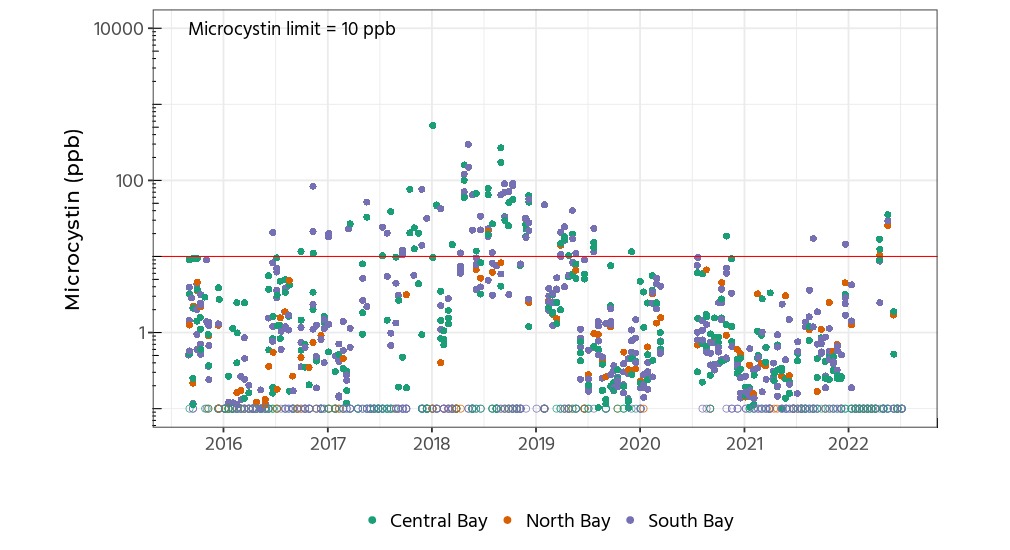
A toxin in shellfish often exceeded concentrations that can trigger public health advisories. Concentrations of microcystin in shellfish by year in the Central, North, and South subembayments of San Francisco Bay.
Technical Appendix

Download PDF
Related Indicators
Thriving Communities Category

Access to Nature
Evaluates how access to parks, trails, and open space is distributed across the Estuary (Under development)
Wetland Decision-Making
Evaluates participation in restoration decision-making (Under development)

Safe for Swimming
Reflects the level of pathogens (microscopic organisms that can cause illness) in Estuary water
Shoreline Recreational Use
Tracks visitor numbers and activity types in shoreline parks (Under development)
Stewardship & Learning
Tracks the levels of participation in shoreline stewardship and education programs (Under development)
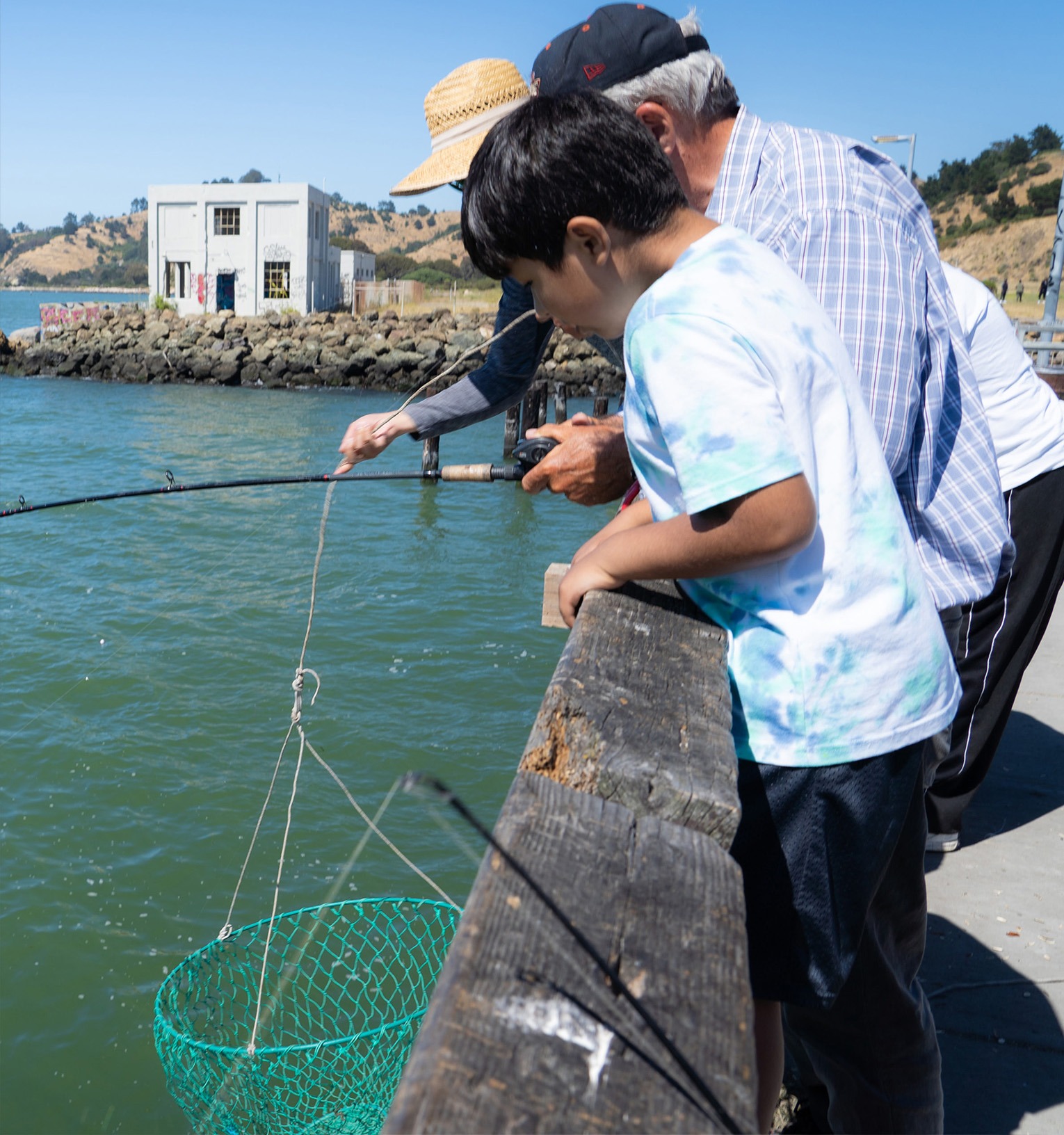
A child fishes with his grandfather off a pier in Point Richmond. Shira Bezalel, SFEI.
Contributing Scientists | Safe for Eating
Jay Davis, PhD, San Francisco Estuary Institute
Citations
-
RMP [Regional Monitoring Program for Water Quality in San Francisco Bay]. 2024.
Contaminant Data Display & Download (CD3). http://sfei.org/rmp -
Davis, J.A., Weaver, M., and Heim, W.A. 2025.
Interpretive Report on Delta RMP Mercury Monitoring: 2016 – 2022. Delta Regional Monitoring Program. https://deltarmp.org/Documents/Mercury_Interpretive_Report_2016-2022.pdf