
Waterfowl
An index of winter abundance for dabbling and diving ducks in the San Francisco Bay

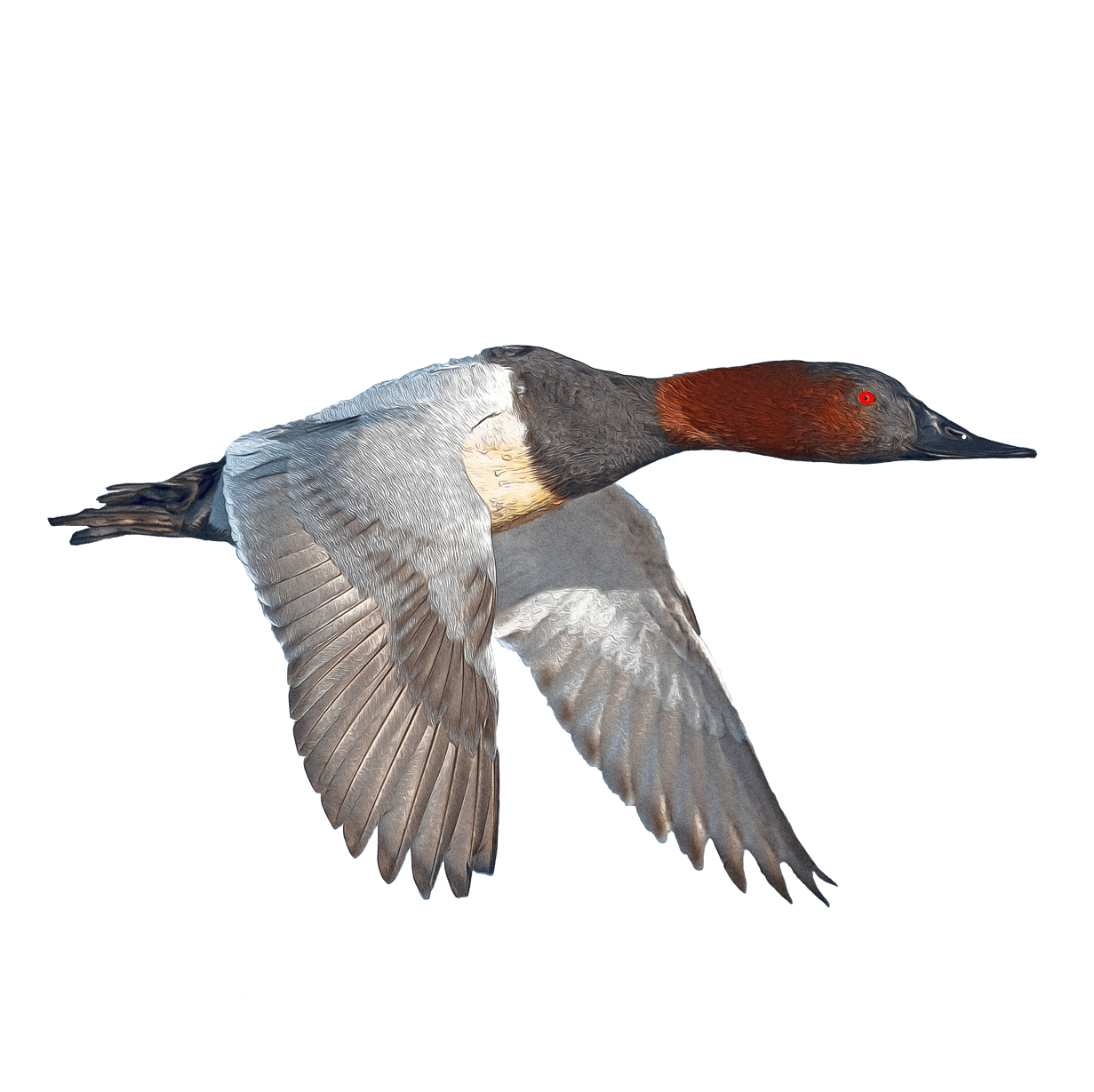
Male Canvasback in flight.
Nearly Three-Quarters of a Million Waterfowl Rely on the Bay Each Winter

Over 30 waterfowl species use a mosaic of Bay habitat types, including tidal marshes, sloughs and flats, managed ponds, open water, and lagoons. In winter, dabbling and diving ducks feed in these habitats to build energy reserves for migration and reproduction. Ducks also provide recreational opportunities for hunters and bird watchers.
Waterfowl
Status & Trend
Dec. 2025


Overall, the status of wintering waterfowl in the San Francisco Bay (excluding Suisun) is Fair, and trend scores (from 1989-2024) are Mixed, because trends differ depending on waterfowl guild and Bay sub-region.
The dabbling duck guild is performing slightly better than the diving duck guild. For dabbling ducks, status and trend scores are Good and Improving in the North Bay, Fair and Declining in the Central Bay, and Good and Improving in the South Bay. For diving ducks, status and trend scores are Poor and Declining in the North Bay and Central Bay, and Fair and Improving in the South Bay.

Full read
Waterfowl in Depth
The San Francisco Bay is one of the most important migratory stopover and wintering areas for waterfowl in the Pacific Flyway, and the North American Waterfowl Management Plan identified the Bay as an area of continental significance for ducks (NAWMP 2004). Dabbling ducks, which feed at the surface or in shallow water, are abundant in the Bay, but the region is particularly noted for supporting large numbers of wintering diving ducks, which dive to the Bay floor to forage in the sediment.
While waterfowl conservation is one objective of Estuary restoration projects, conversion of non-tidal habitats such as former salt production ponds and agricultural fields to tidal marshes has the potential to negatively impact waterfowl abundance since these habitats provide foraging and roosting areas for many waterfowl species (Takekawa et al. 2009, Brand et al. 2014). To help offset this, some remaining ponds are managed at optimal depths and salinities to support waterfowl.
Dabbling duck abundance in the North and South Bays, where large tidal marsh restoration and non-tidal management projects have been implemented, has increased significantly over the long-term, although shorter-term trends (2011-2024) show a non-significant downward trajectory. This may reflect an initial positive response to early restoration and management efforts, and a subsequent equilibrium in dabbling duck abundance as wetland habitat continues to evolve. In the Central Bay, where their abundance has always been lowest, both long- and short-term trends indicated significant annual declines for dabbling ducks.
Diving duck abundance has declined significantly in the North and Central Bays but has increased significantly in the South Bay. The greatest declines in diving ducks were in open bay habitat, where species composition tends to be dominated by scaup and scoter species (Richmond et al. 2014, Strong 2019). In contract, the greatest increases for this guild were in the South Bay Salt Ponds, where ruddy ducks have been shown to be the dominant diving duck species (Richmond et al. 2014, Strong 2019), and where much of the pond habitat currently is managed to optimize depth and foraging resources for waterfowl (Brand et al. 2014, De La Cruz et al. 2018).
In addition to restoration and management, several other factors also have the potential to change the timing, quality, and quantity of habitat availability for waterfowl in the region, including drought, predicted reductions in freshwater flow, rising sea levels, and infrastructure redesign throughout the Bay (Kruse et al. 2003, Thorne et al. 2018, Barnard et al. 2019, Tremain et al. 2019). These multiple interacting factors in the Bay, coupled with those affecting birds on their migratory routes or breeding areas, can make it challenging to tease apart the impacts of specific restoration and management actions from the variety of other influences on waterfowl abundance in the Bay.
Additional species and habitat-specific analyses of waterfowl trends in the Bay are highlighted in the San Francisco Bay State of the Birds.
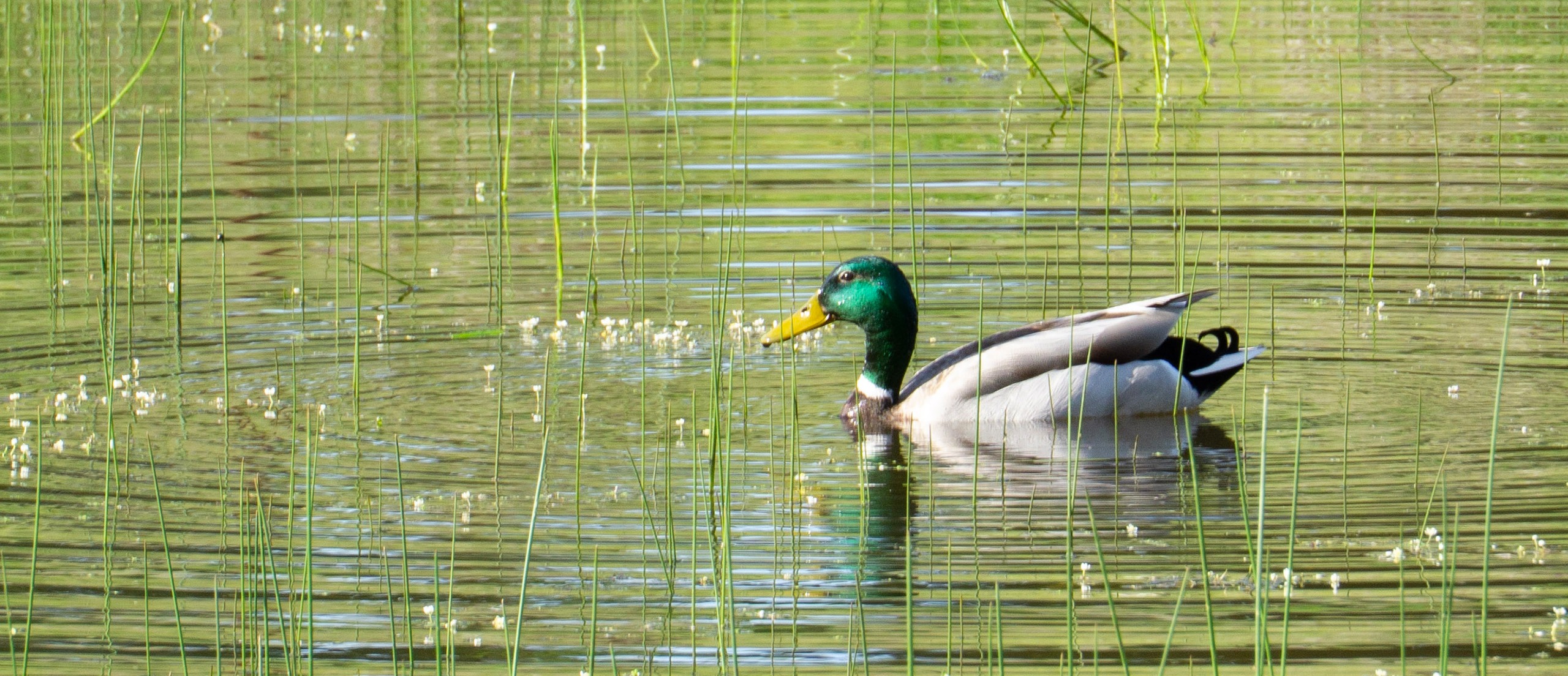
A Mallard wades through water. Ben Botkin, SFEP.
How was this Indicator Calculated?
Data Used
We used data from the 1989-2024 U.S. Fish and Wildlife Service Midwinter Waterfowl Surveys (MWS; Accurso 1992, U.S. Fish and Wildlife Service 2009), and monthly waterbird survey data from the South Bay Salt Ponds Restoration Project collected by San Francisco Bay Bird Observatory and United States Geological Survey (De La Cruz et al. 2018, Van Schmidt and Parsons 2024).
Indicator Approach
We calculated an annual index of abundance for dabbling duck and diving duck guilds for each sub-region.
- We used data from the six most abundant species of dabbling ducks—American Wigeon (Mareca americana), Gadwall (M. strepera), Green-winged Teal (Anas crecca), Mallard (A. platyrhyncos), Northern Pintail (A. acuta), and Northern Shoveler (Spatula clypeata).
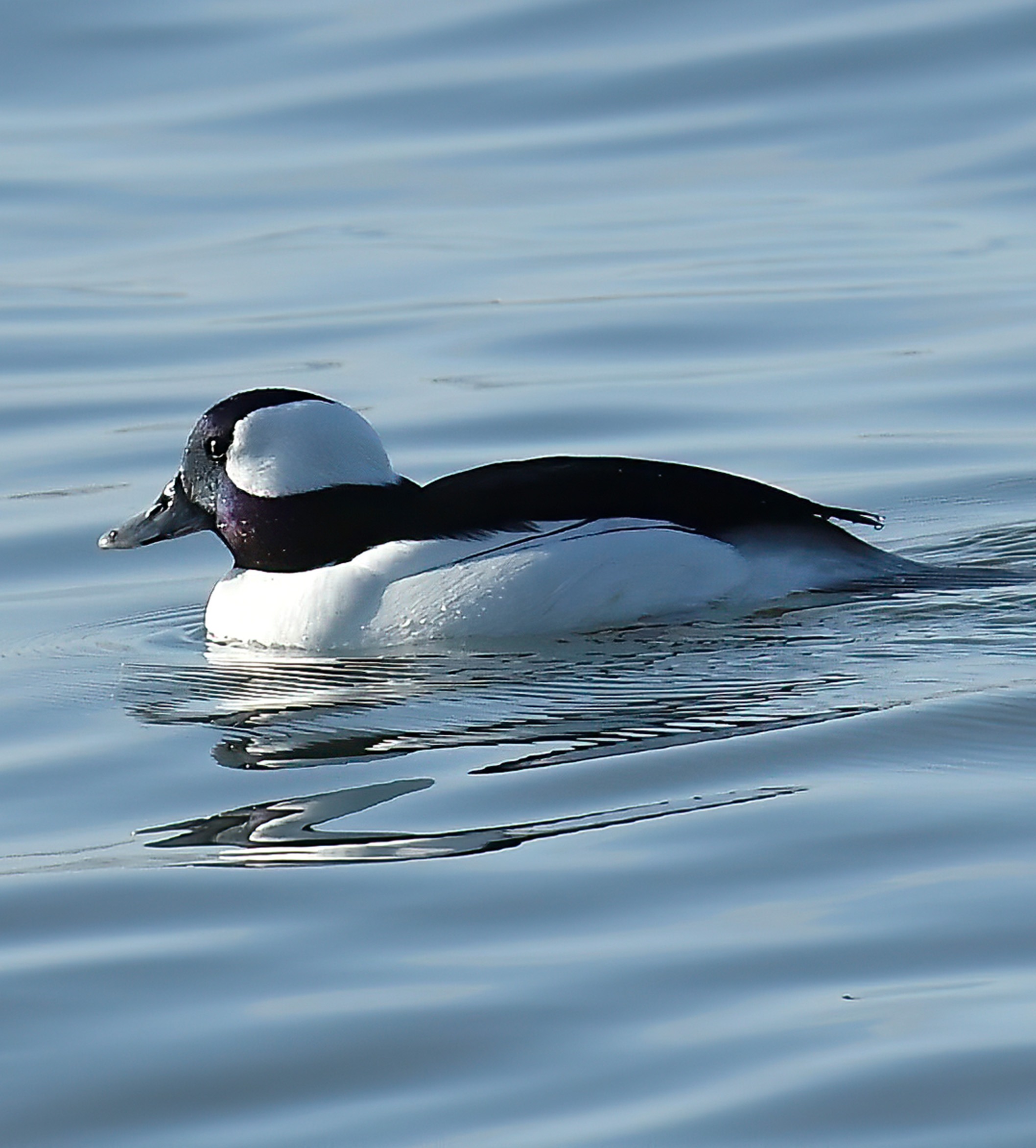
- And the six most abundant diving duck species groups—Bufflehead (Bucephala albeola), goldeneye (Common Goldeneye (B. clangula) and Barrow’s Goldeneye (B. islandica)), Canvasback (Aythya valisineria), scaup (Greater Scaup (Aythya marila) and Lesser Scaup (A. affinis)), Ruddy Duck (Oxyura jamaicensis), and scoter (Black Scoter (Melanitta americana), White-winged Scoter (M. deglandi), and Surf Scoter (M. perspicillata)).
We grouped abundances from effort-adjusted annual species counts into dabbling and diving duck guilds. We then applied a natural log plus one transformation to calculate an annual abundance index for each sub-region. Data collection methods are described in detail in Accurso (1992), Richmond et al. (2014), and Strong et al. (2019).
Benchmarks and Scoring
We delineated benchmarks by calculating the percent change in mean abundance for dabbling and diving ducks in the first five years of the time series analyzed (i.e., baseline period, 1989-1993) and the five most recent surveys (i.e., current period, 2016, 2018, 2020, 2023, and 2024), and determined significance with generalized linear models (α = 0.05). An abundance increase of 40% or more and a statistically significant increase in the corresponding abundance index received a status of Good. A decrease in abundance of 40% or more, accompanied by a significant decrease in the abundance index, was scored as Poor. All other changes in abundance received a status of Fair.
For Trend scores, we used generalized linear models to estimate and determine the significance (α = 0.05) of the annual percent change in index scores (1989-2024) for each guild and sub-region. Significantly negative or positive trends were scored as Improving or Declining, respectively, and No Change when percent annual change estimates were not significant (P > 0.05). Scores for each guild and sub-region were rolled up to a single Trend score of Improving, Declining, No Change, or Mixed.
Technical Appendix

Download PDF
Related Indicators
Flourishing Wildlife Category

Harbor Seals
Tracks adult harbor seal abundance in the San Francisco Bay during the breeding season (Under development)
Native Fish
Measures the abundance, species diversity, species composition, and distribution of native fishes in the San Francisco Estuary
Ridgway's Rail
Tracks Ridgway’s Rail population density in tidal marsh habitats of the San Francisco Bay (Under development)
Shorebirds
Tracks winter densities of migratory shorebirds in the San Francisco Bay
Tidal Marsh Birds
An index of breeding population density for three tidal marsh bird species in the San Francisco Bay
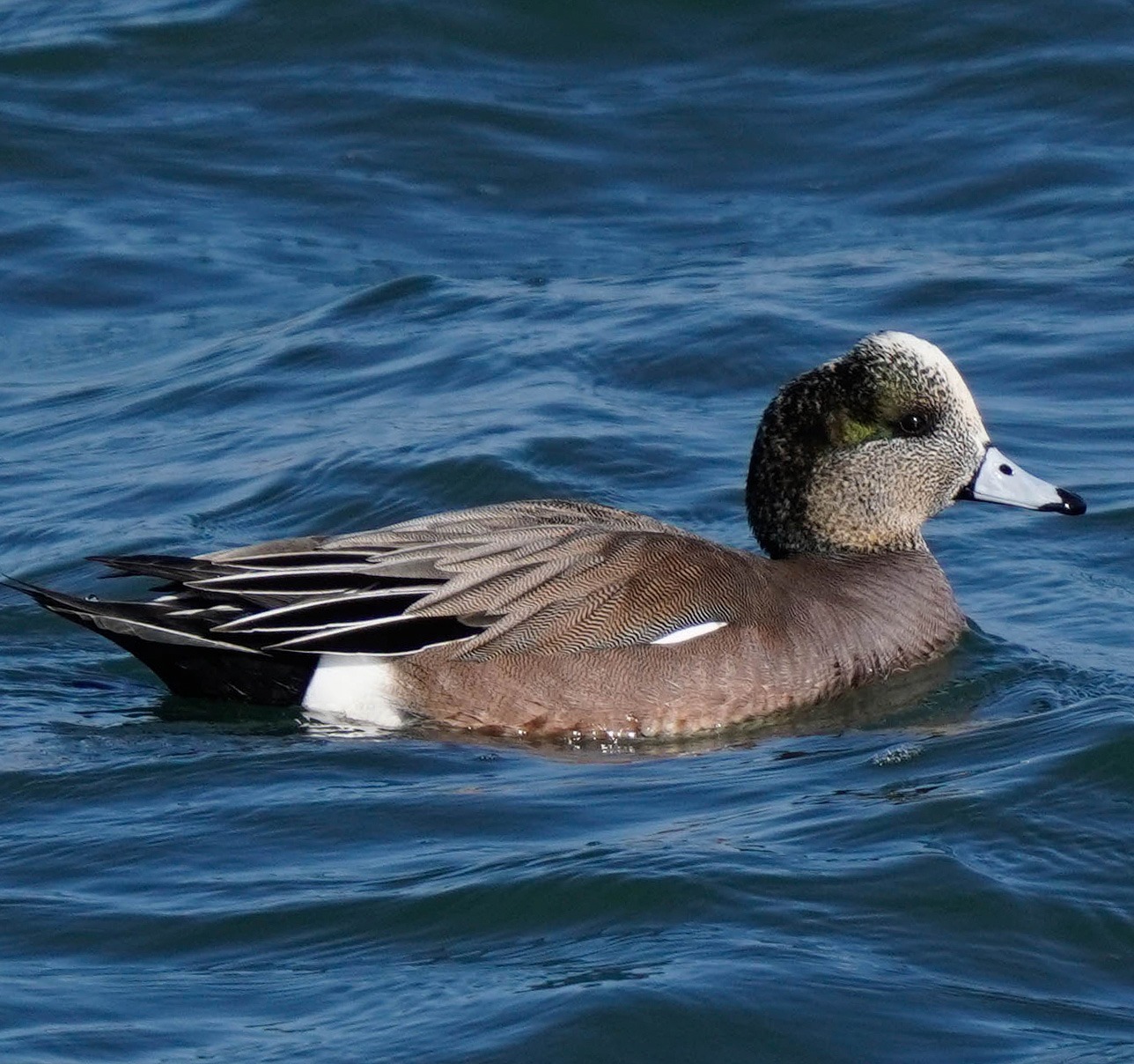
American Wigeon. William Chan, Western Ecological Research Center, USGS.
Contributing Scientists | Waterfowl
Susan E. W. De La Cruz, PhD, United States Geological Survey, Western Ecological Research Center
Laurie Hall, PhD, United States Geological Survey, Western Ecological Research Center
Tanya Graham, MS, United States Geological Survey, Western Ecological Research Center
Nadav Nur, PhD, Point Blue Conservation Science
Nathan Van Schmidt, PhD, San Francisco Bay Bird Observatory
Citations
-
Accurso, L. M. 1992.
Distribution and abundance of wintering waterfowl in San Francisco Bay, 1988–1990. Unpublished Master’s Thesis, Humboldt State University. Arcata, CA, pp. 252. -
Kruse, K. L., J. R. Lovvorn, J. Y. Takekawa, and J. Mackay. 2003.
Winter distribution and survival of a high-desert breeding population of canvasbacks. The Condor 105:791–804. -
NAWMP [North American Waterfowl Management Plan]. 2004.
Strengthening the Biological Foundation. North American Waterfowl Management Plan. -
USFWS [United States Fish and Wildlife Service]. 2009.
Waterfowl population status. U.S. Department of the Interior, Washington, D.C. -
Takekawa, J. Y., A. K. Miles, D. C. Tsao-Melcer, D. H. Schoellhamer, S. Fregien, and N. D. Athearn. 2009.
Dietary flexibility in three representative waterbirds across salinity and depth gradients in salt ponds of San Francisco Bay. Hydrobiologia 626:155–168. -
Brand, L. A., J. Y. Takekawa, J. Shinn, T. Graham, K. Buffington, K. Ben Gustafson, L. M. Smith, S. E. Spring, and A. K. Miles. 2014.
Effects of wetland management on carrying capacity of diving ducks and shorebirds in a coastal estuary. Waterbirds 37:52–67. -
Richmond, O. M. W., S. Dulava, C. M. Strong, and J. D. Albertson. 2014.
National wildlife refuge system inventory and monitoring initiative San Francisco Estuary midwinter waterfowl survey: 2012 survey results and trend analysis (1981–2012). Fremont, CA. -
De La Cruz, S. E. W., L. M. Smith, S. M. Moskal, C. Strong, J. Krause, Y. Wang, and J. Y. Takekawa. 2018.
Trends and Habitat Associations of Waterbirds Using the South Bay Salt Pond Restoration Project, San Francisco Bay, California. U.S. Geological Survey Open File Report No. 2018-1040. Vallejo, CA. -
Thorne, K., G. MacDonald, G. Guntenspergen, R. Ambrose, K. Buffington, B. Dugger, C. Freeman, C. Janousek, L. Brown, J. Rosencranz, J. Holmquist, J. Smol, K. Hargan, and J. Takekawa. 2018.
U.S. Pacific coastal wetland resilience and vulnerability to sea-level rise. Science Advances 4:1–11. -
Barnard, P. L., L. H. Erikson, A. C. Foxgrover, J. A. Finzi Hart, P. Limber, A. C. O’Neill, M. van Ormondt, S. Vitousek, N. Wood, M. K. Hayden, and J. M. Jones. 2019.
Dynamic flood modeling essential to assess the coastal impacts of climate change. Scientific Reports 9:1–13. -
Tremain, K., K. Bayer, J. Vandever, and B. Freitas. 2019.
State Route 37 alternatives assessment report for the ultimate project: State Route 37 from State Route 121 to the Mare Island interchange. -
Strong, C. M. 2019.
San Francisco Estuary Midwinter Waterfowl Survey: 2013–2018 Summary Results. -
Van Schmidt, N. D., and A. Parsons. 2024.
South Bay Salt Pond Waterbird Surveys September 2023 – May 2024. Milpitas, CA.